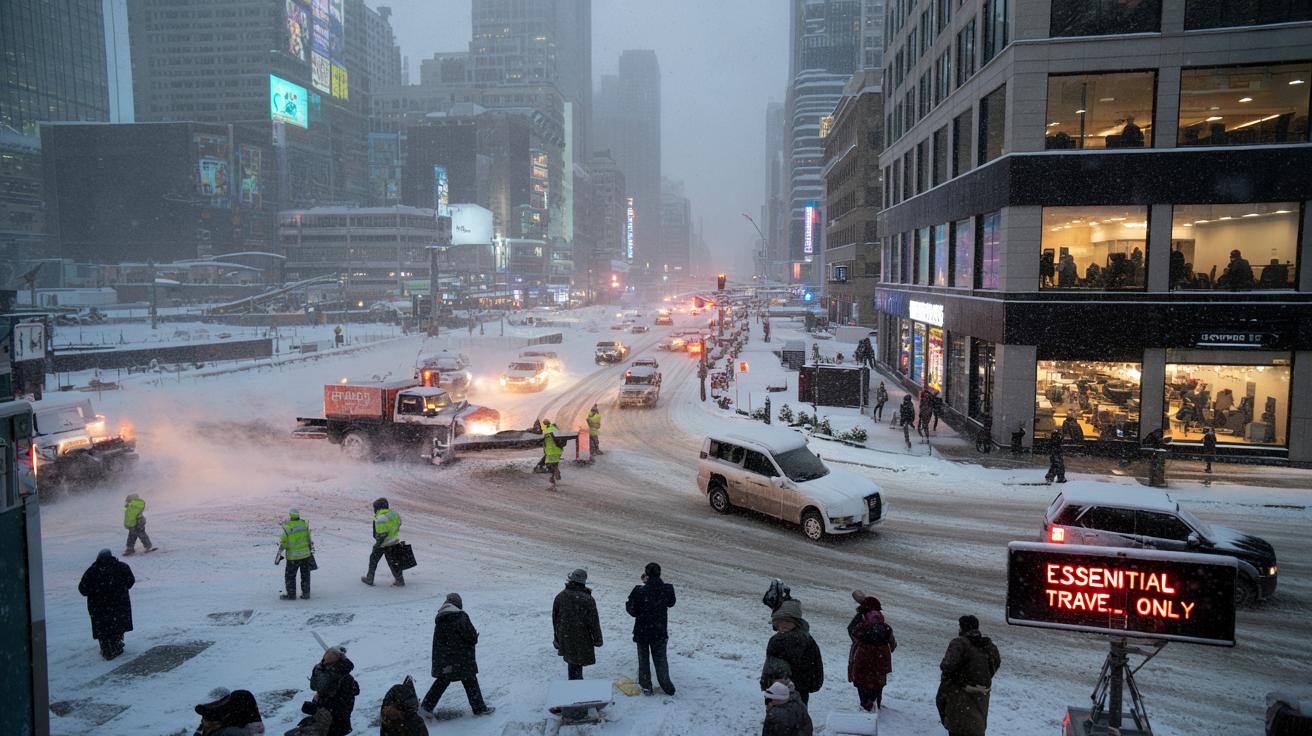
The first flakes started falling just after lunch, the kind you almost ignore at first. People in heavy coats hunched over their phones, scrolling the same alert: “Snowfall upgraded. Arrival earlier than forecast.” No one really slowed down. Delivery scooters still weaved between cars, a cyclist balanced two grocery bags on his handlebars, and office windows stayed lit as if the sky wasn’t darkening by the minute.
At the tram stop, a woman in heels cursed under her breath as the platform turned slippery. Somewhere behind us, a siren wailed longer than usual.
The snow picked up so fast you could actually see the city losing its outlines.
And still, most businesses stayed open, pretending it was just another winter day.
Until it clearly wasn’t.
Heavy snow is no longer “later tonight” — it’s now
The official confirmation came like a push notification sucker punch: the massive snow front that was expected overnight had sped up and was now locked onto major cities. Forecasts that once said “late evening” suddenly read “late afternoon”, which in real life means rush hour colliding with a full-on whiteout. Streets that were merely wet at noon started turning white by three, while digital billboards flashed warnings about “essential travel only”.
Up in city halls, emergency teams gathered in fluorescent-lit rooms. On the ground, people just kept walking, shaking their umbrellas and telling themselves, “It’ll calm down.”
At one downtown intersection, the contradiction was almost surreal. One side of the street was a line of city trucks already loading salt, workers in reflective vests shouting over the wind. The other side? A coffee shop pushing a “Happy Hour” chalkboard sign out onto the increasingly icy sidewalk, as if the storm watch were just background noise.
Inside a nearby tech office, staff watched live radar maps on a big screen while their manager sent a group email: “Given the forecast, those who can leave early should consider it.” Half of them stayed anyway. Deadlines. Client calls. That stubborn office pride that says, “Snow days are for kids, not for us.”
Meteorologists had warned all week about a “fast-moving system”, but the speed still caught people off guard. Warmer-than-usual air ahead of the front gave a false sense of safety; then a sharp drop in temperature turned wet roads into hidden ice in under an hour. That’s the dangerous window, when everything still looks manageable but the physics of stopping a car have quietly changed.
➡️ HVAC pros explain why closing vents in unused rooms actually increases heating bills
➡️ I kept turning up the heat and still felt cold: experts explain this common home problem
➡️ How a single houseplant in the bedroom increases deep sleep phases by 37%, nasa study
➡️ How your birth order determines your personality more than genetics (the research)
Emergency planners know this pattern too well. The models shift, the timing tightens, and suddenly you’re deciding in real time if schools should stay open, if buses should keep running, if non-essential activity should pause. The storm doesn’t wait for a press conference. It just keeps moving.
Restrictions, refusals, and that awkward middle zone
Behind the scenes, officials are now weighing a menu of emergency restrictions. Talk of early public transport shutdowns. Temporary bans on heavy trucks in city centers. Reduced speed limits, staggered closing times for major employers. All of this is being debated while snow piles up quietly outside their windows.
The tricky part is timing. Go too early, and you’re blamed for overreacting. Go too late, and you’re the reason hundreds of drivers are stuck sideways on a ring road, headlights buried in white. No one wants to push the red button first, especially when the city is still half-pretending everything is normal.
On one busy commercial avenue, you can already see the divide. A pharmacy taped a handwritten note to the door: “Closing at 4 pm due to weather — sorry for the inconvenience.” Next door, a big-box store posted a bright digital message: “Open as usual!” with a smiling snowflake logo. Staff inside were quietly messaging their families, trying to figure out how they’d get home if buses stopped early.
We’ve all been there, that moment when you stare out the office window and wonder if you’re being cautious or paranoid. One restaurant manager told me, “We lose thousands if we close for a full night, and nobody pays us back for that.” A nurse on her lunch break, overhearing him, just shook her head and said softly, “We lose more if the ambulance can’t get through.”
This clash between public safety and economic pressure isn’t abstract. It shows up in the small, very human decisions people are forced to make under a darkening sky. Many businesses operate on razor-thin margins already; closing “just in case” can feel like jumping off a financial cliff. At the same time, city authorities carry the weight of what happens when too many people try to move at once on roads that have quietly turned into glass.
Let’s be honest: nobody really reads those long winter safety PDFs the city emails out every year. People react to what they see out the window, to what their boss says, to whether their group chat is full of “heading home now” messages. That’s why officials are now experimenting with sharper, simpler messages and real-time alerts — not just “expect snow”, but “leave work by 4 pm if you can” or “avoid this specific highway between 5 and 7 pm”. One clear instruction beats a dozen vague warnings.
How to navigate a city that’s still open while the snow closes in
If you’re reading this with the snow already starting to stick outside, there’s one practical thing you can do: decide your personal “cut-off time” before the city decides for you. Look at the latest forecast, pick a realistic hour by which you’ll be on your way home, and plan backwards. That means wrapping up tasks earlier, cancelling non-essential errands, and saying no to the “quick drink after work” that always turns into an extra hour.
Think in concrete steps, not vague intentions. Charge your phone. Pack a small bag with water, a snack, a portable charger, and warm gloves. It sounds dramatic until you’re on a stalled tram in the dark, watching battery percentage tick down.
A common mistake in these situations is waiting for someone “official” to give you permission to change your plans. We lean hard on the idea that if shops are open and trains are running, then everything must be fine. *That illusion melts about as fast as the first layer of snow on a warm pavement.*
If your gut says “leave now”, listen to it. Snowstorms don’t turn your caution into drama, they turn your denial into risk. Talk to your manager earlier in the day rather than five minutes before closing, when everybody is panicking at once. And if you’re a manager yourself, remember that nobody will complain tomorrow that you let them go a bit too early. They will complain, loudly, if they end up stuck overnight in a parking lot.
“Storms always expose the gaps between our policies and our habits,” one emergency planner told me. “We can write all the protocols we want, but what people do between 3 and 5 pm on a snowy weekday often decides how bad the night gets.”
- Decide early: Pick your own safe departure time based on updated forecasts, not wishful thinking.
- Travel light but smart: Keep a small “winter kit” — hat, gloves, phone charger, snack — at work or in your bag.
- Ask clear questions: Instead of waiting, directly ask your employer, “What’s the plan if the snow intensifies by late afternoon?”
- Use trusted sources: Rely on official city apps, public transport accounts, and local weather services rather than viral screenshots.
- Respect the crews outside: If restrictions arrive, they’re not about spoiling your plans; they’re about giving road and emergency teams a fighting chance.
The storm is also a mirror
Beyond the forecasts and alerts, this sudden acceleration of heavy snow is exposing something deeper about how our cities move, work, and care for people. When a weather system speeds up, all the slow parts of our decision-making are laid bare. The companies that hold off closing until the last possible minute. The workers who can’t afford to leave early. The invisible line between “essential” and “expendable” that only seems to appear when the streets turn white.
Snow has a way of equalizing the landscape but not the consequences. Some people can work remotely, watching the storm through a window. Others will be out there in it — driving buses, delivering food, keeping hospitals running — while scrolling rumors of restrictions that may or may not arrive in time. These are the small, granular stories that never make the official bulletins but define how a city actually lives through a storm.
Maybe that’s the quiet question behind this whole episode: not just how fast the snow is coming, but how quickly we’re willing to adjust our habits when reality clearly changes. A storm like this doesn’t just cover roads and roofs; it draws a sharp, white outline around our priorities.
What we decide in those few compressed hours — as forecasts tighten, alerts ping, and shop lights stay stubbornly on — says a lot about who we’re really protecting when the weather turns against us.
| Key point | Detail | Value for the reader |
|---|---|---|
| Snow arriving sooner | Forecasts shifted from “late evening” to “late afternoon” for major cities | Helps you understand why your day may suddenly be disrupted |
| Restrictions under discussion | Officials weighing early transport cutbacks, truck bans, and slower speed limits | Prepares you mentally for last-minute changes to your commute |
| Personal action matters | Choosing your own departure time and safety plan instead of waiting passively | Gives you back some control in a fast-changing situation |
FAQ:
- Question 1What does it mean when heavy snow is “officially confirmed” for a city?It usually means national or local meteorological agencies have high confidence in both the intensity and timing of the snow, and have often upgraded alerts to an orange or red level, which can trigger emergency planning.
- Question 2Should I go to work if a major snowstorm is expected earlier than planned?This depends on your job, your employer’s policy, and transport options. If you must go, talk with your manager early about leaving sooner than usual and monitor official updates throughout the day.
- Question 3Why do some businesses refuse to close even when conditions are risky?Many rely on daily income to survive and fear financial loss or customer backlash if they shut down. Some also wait for clear government instructions instead of taking the initiative.
- Question 4What kind of emergency restrictions can cities introduce during heavy snow?Common measures include reduced speed limits, truck travel bans, early closure of public transport lines, parking bans on key routes, and strong recommendations to avoid non-essential travel.
- Question 5How can I stay informed without getting lost in rumors and panic posts?Follow official city and transport accounts, use trusted weather apps, and rely on local radio or TV alerts. Be cautious about screenshots or forwarded messages that lack a clear source.